
The Driver Immunity Myth
Most Drivers Think FMCSA Can't Fine Them Personally. They're Wrong.
Ask most company drivers or owner-operators if the FMCSA can fine them personally, and you’ll usually hear the same answer.
“No. The company gets fined. I only have to worry about traffic tickets.”
The belief is widespread throughout the industry.
It’s also wrong.
Many drivers assume that federal enforcement stops with the motor carrier. They believe the company’s DOT number absorbs the consequences while the driver only deals with local citations and court appearances.
The reality is very different.
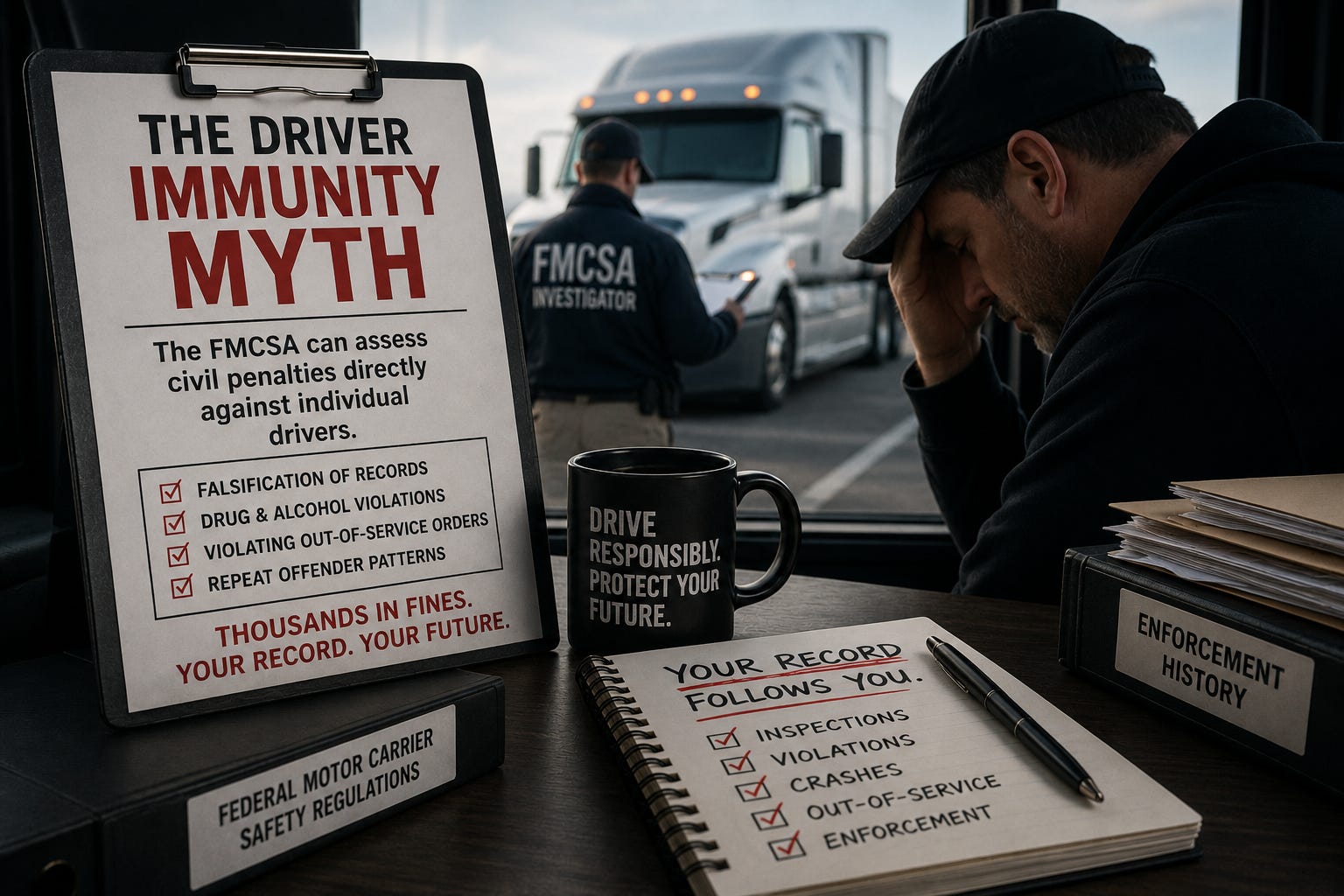
The FMCSA has clear statutory authority to assess civil penalties directly against individual commercial drivers for certain violations of the Federal Motor Carrier Safety Regulations.
In other words, federal investigators are not limited to pursuing motor carriers.
Under the right circumstances, they can come after you personally.
And when they do, the penalties can reach thousands of dollars for a single violation.
Why Drivers Believe the Myth
Most drivers only see one side of the enforcement system.
A roadside inspector conducts an inspection.
A violation is discovered.
Paperwork gets issued.
The driver leaves.
The carrier handles the fallout.
Because that is the experience most drivers see, they naturally assume the carrier absorbs all federal consequences.
But roadside inspections are only one piece of a much larger system.
Behind every inspection is a data infrastructure that tracks drivers, carriers, inspections, violations, crashes, out-of-service orders, and enforcement actions.
Federal investigators do not simply review companies.
They review patterns.
And those patterns often lead directly back to individual drivers.
Traffic Tickets vs. Federal Enforcement
A speeding ticket and a federal enforcement action are not the same thing.
Traffic citations are generally handled through local courts.
Federal enforcement actions stem from violations of the Federal Motor Carrier Safety Regulations.
The FMCSA has the authority to investigate those violations and assess civil penalties against drivers when the facts support it.
The question is not whether a local judge found you guilty.
The question is whether your conduct violated federal safety regulations.
That distinction catches many drivers by surprise.
Violations That Can Trigger Personal FMCSA Fines
Not every violation results in direct enforcement against the driver.
However, several categories routinely place drivers at risk.
Falsification of Records
Hours-of-service records remain one of the most heavily scrutinized areas of transportation enforcement.
Examples include:
Creating false log entries
Running ghost logs
Operating under another driver’s account
Altering records to conceal driving time
Manipulating ELD data
Intentionally certifying false records
Many drivers view logbook violations as paperwork issues.
Investigators do not.
Hours-of-service regulations exist to prevent fatigue-related crashes. When investigators discover intentional falsification, they view it as a deliberate attempt to defeat a safety system.
Civil penalties for knowingly falsifying records can reach well into the thousands of dollars depending on the facts of the case and the number of violations involved.
Drug and Alcohol Violations
Drug and alcohol regulations carry some of the most severe consequences in trucking.
Examples include:
Operating a commercial motor vehicle while prohibited substances are present
Refusing a required drug or alcohol test
Operating while disqualified
Failing to comply with return-to-duty requirements
Many drivers assume criminal charges must exist before federal action can occur.
That is not true.
Federal enforcement operates independently from local criminal proceedings.
A driver can face federal penalties even when the matter never results in a criminal conviction.
Violating an Out-of-Service Order
This is one of the fastest ways to attract federal attention.
When an inspector places a driver out of service, the expectation is simple:
Do not move the truck.
Out-of-service orders are issued because an immediate safety concern exists.
Examples include:
Hours-of-service violations
Medical qualification issues
Drug and alcohol disqualifications
Serious safety concerns identified during enforcement activity
Drivers who ignore an out-of-service order expose themselves to substantial civil penalties that can reach several thousand dollars for a single occurrence.
From an investigator’s perspective, these cases are particularly serious because the driver made a conscious decision to ignore a direct safety order.
The Repeat Offender Problem
This is where many drivers misunderstand how federal enforcement actually works.
Most people assume every violation starts with a clean slate.
It doesn’t.
Federal investigators have access to years of inspection, crash, and enforcement data.
Every roadside inspection.
Every violation.
Every out-of-service order.
Every carrier you worked for.
The data follows you.
A single violation may not attract significant attention.
A pattern of violations is different.
A driver who repeatedly generates the same violations across multiple carriers begins creating a history.
That history tells a story.
Imagine two drivers.
The first driver receives a single hours-of-service violation after years of clean inspections.
The second driver accumulates multiple hours-of-service violations, multiple logbook discrepancies, and multiple out-of-service orders while working for three different carriers over several years.
Both drivers violated the regulations.
But investigators do not view those situations the same way.
One appears to be a mistake.
The other appears to be a pattern.
And patterns attract attention.
How Investigators Think
One of the biggest misconceptions in trucking is that investigators only care about what happened during the latest inspection.
That is not how the system works.
The FMCSA’s enforcement philosophy is risk-based. Investigators are trained to identify safety problems, determine the source of those problems, and apply the least resource-intensive intervention necessary to correct them.
That means investigators are constantly asking questions such as:
Is this an isolated event?
Is this a recurring problem?
Does this behavior appear intentional?
Is the carrier causing the problem?
Is the driver causing the problem?
Is this conduct creating ongoing risk?
Those questions matter.
Because once an investigator concludes the driver is the common denominator, the focus can begin shifting away from the carrier and toward the individual.
Why This Matters to Drivers
Many drivers focus entirely on what happens at the scale house.
Experienced investigators focus on what happens over time.
Patterns matter.
Trends matter.
Data trails matter.
A driver who develops a reputation for false logs, substance violations, repeated out-of-service orders, or chronic noncompliance can create problems that follow them long after they leave a particular company.
The trucking industry runs on records.
And those records never forget.
The Bottom Line
The belief that only motor carriers face FMCSA penalties is one of the most persistent myths in trucking.
Motor carriers absolutely face enforcement.
But drivers are not immune.
Federal investigators possess the authority to pursue individual drivers when the facts justify it.
Understanding where that line exists is critical for every company driver and owner-operator operating under federal regulations.
Because by the time an investigator starts looking at you individually, the problem is usually much larger than a single roadside violation.